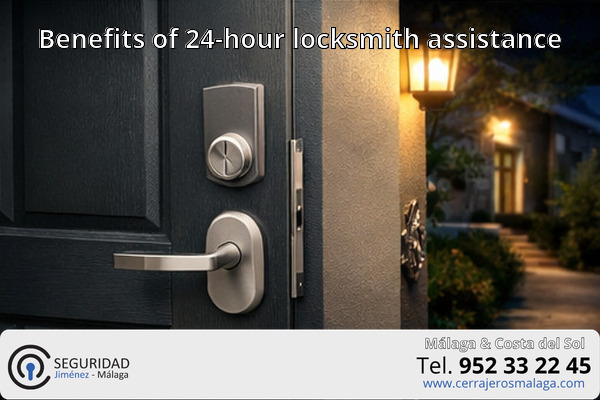
Have you ever found yourself locked out of your home late at night, feeling anxious and unsure of what to do next? In homes across Málaga, such situations can arise unexpectedly. That’s where 24-hour locksmith assistance comes into play, offering peace of mind and immediate solutions at any hour of the day or night.
What 24-hour locksmith assistance is and what it is used for
24-hour locksmith assistance is an emergency service that provides technical support for residential access problems at any time of day or night. It may be required when a door cannot be opened, a key has been lost, a lock has failed or an immediate security measure is needed.
In practical terms, continuous availability helps address incidents that cannot reasonably be postponed until normal business hours. Typical services may include professional door opening, lock or cylinder replacement, repair of damaged mechanisms and temporary or permanent security measures, depending on the condition of the installation.
The appropriate intervention depends on the type of door, the locking mechanism, the cause of the incident and whether the priority is restoring access, securing the property or both. A technical assessment should take place before selecting a solution, particularly when the lock is damaged or the door forms part of a wider access system.
When 24-hour locksmith assistance may be necessary
Round-the-clock assistance can be useful when an access problem occurs outside ordinary working hours or when leaving the property unsecured could create an avoidable risk. The service is not limited to lockouts; it can also cover situations in which a damaged or worn mechanism no longer provides reliable protection.
- Lost or stolen keys: changing the cylinder may be advisable when the keys could be used by an unauthorised person.
- Blocked access: a key may not turn, the latch may remain engaged or an internal component may have failed.
- Broken or worn locks: continued use can increase damage and make a later intervention more complex.
- Damaged keys: a bent, cracked or partially broken key can affect the mechanism and should be assessed before it causes a complete blockage.
- Urgent change of access: a lock may need to be replaced after a change in occupants, a security incident or the loss of control over copies.
- Security concerns after an incident: a professional can evaluate whether the door, cylinder, escutcheon and frame remain correctly protected.
Emergency assistance may not be necessary when the problem is limited to a misplaced key that is safely recovered and the lock functions normally. Even in that situation, a cylinder should be assessed if there is a possibility that the key has been stolen or copied.
Problems and risks that the service can help prevent
Prompt technical attention can reduce the consequences of a malfunction, although it cannot eliminate every security risk. The main benefit is the possibility of diagnosing the problem before a temporary fault develops into a complete failure or leaves the property exposed.
- Unauthorised access: replacing a cylinder after keys are lost can reduce the risk associated with uncontrolled copies.
- Repeated lockouts: identifying wear, alignment problems or internal damage may prevent recurring access failures.
- Further mechanical deterioration: forcing a stiff key or repeatedly operating a defective lock can worsen the fault.
- Loss of door functionality: a lock that does not close or latch correctly may affect both access and basic property security.
- Unprotected temporary access: a technical assessment can determine whether an interim measure is appropriate until a permanent repair is possible.
- Compatibility problems: selecting a component without checking the door and existing mechanism can create new operating or security issues.
Emergency work should remain proportionate to the problem. If the installation is functional and there is no immediate risk, a planned repair or replacement may allow more time to compare suitable components.
How a 24-hour locksmith intervention is carried out
A professional intervention should follow a structured process. The exact procedure varies according to the type of door, the lock installed and the reason for requesting assistance.
- Initial assessment: the technician identifies the access problem, confirms the location and gathers relevant information about the door and locking system.
- Diagnosis of the existing system: the condition of the cylinder, lock case, handles, hinges, frame and closing points is considered where they affect the incident.
- Selection of the appropriate solution: the decision may involve restoring operation, replacing a component, changing the cylinder or applying a temporary security measure.
- Technical intervention: work is carried out using a method consistent with the installation and the objective of the service, while avoiding unnecessary damage.
- Final checks: the door should be tested from the relevant sides, and the correct operation of the key, latch, deadbolt and closing points should be verified where applicable.
Before work begins, it is also reasonable to verify that the person requesting access is authorised to enter the property. This protects the occupant, the owner and the technician, especially when the request concerns a home, rented property or shared building.
Related solutions and access systems
| Solution | When it is used | Advantages | Limitations |
|---|---|---|---|
| Professional door opening | When the occupant cannot enter and the mechanism or key is preventing access | Focuses on restoring access while assessing the cause of the blockage | It may not resolve underlying wear or damage if the lock requires replacement |
| Cylinder replacement | After lost keys, suspected unauthorised copies or a defective cylinder | Changes the key-operated part without necessarily replacing the entire lock case | Compatibility with the door, escutcheon and lock must be verified |
| Lock repair | When the mechanism is damaged but suitable for repair | May preserve the existing installation and address a specific fault | Repair may not be appropriate when wear is extensive or components are unavailable |
| Complete lock replacement | When the internal mechanism is severely damaged or unsuitable for continued use | Allows the locking assembly to be renewed as a whole | Requires checking dimensions, door preparation and compatibility with existing fittings |
| Electronic or smart access system | When residential access requirements justify a change from a conventional key system | May provide alternative authentication and reduce dependence on physical keys | Requires power, configuration, maintenance and compatibility assessment |
Common situations in residential interventions
Lost keys outside normal working hours
Situation: An occupant cannot locate the keys and is unsure whether they were lost or taken.
Problem detected: Access is unavailable and the existing cylinder may no longer offer adequate control over who can use the key.
Technical assessment: The professional considers the condition of the cylinder, the type of door and whether the priority is entry, replacement or both.
Usual solution: Access is restored through an appropriate professional intervention, followed by cylinder replacement when the loss creates a security concern.
Expected result: The occupant regains access and, where replacement is necessary, the previous keys no longer operate the new cylinder.
A lock that suddenly becomes difficult to operate
Situation: The key has been increasingly difficult to turn and eventually stops operating the lock correctly.
Problem detected: The cause may involve internal wear, a misaligned door, pressure on the locking points or damage to the key.
Technical assessment: The technician distinguishes between a problem in the key, the cylinder, the lock case or the door alignment before recommending a replacement.
Usual solution: The affected component is repaired or replaced according to its condition, and the closing geometry is checked.
Expected result: The door operates more reliably, provided that the frame and other associated components are also in suitable condition.
A door that does not close correctly after an incident
Situation: A resident notices that the door no longer latches or that the key does not complete its normal movement.
Problem detected: The locking mechanism, strike area, hinges or frame may have been affected.
Technical assessment: The complete closing assembly is examined rather than replacing only the visible component.
Usual solution: The necessary repair or replacement is selected after determining whether the fault is mechanical, structural or related to alignment.
Expected result: The door should close and lock correctly after the relevant components have been adjusted or renewed.
Frequent mistakes and how to avoid them
| Mistake | Consequence | Technical recommendation |
|---|---|---|
| Continuing to use a key that is bent or difficult to turn | Additional wear, key breakage or complete blockage | Stop repeated attempts and request an assessment of the key and cylinder |
| Replacing only the visible part without diagnosing the system | The underlying fault may remain and the new component may not operate correctly | Check the cylinder, lock case, door alignment and closing points together |
| Choosing a component solely by appearance | Incorrect dimensions or incompatibility with the existing installation | Verify measurements, fixing points, door type and relationship with the lock |
| Using excessive force on the door or key | Damage to the mechanism, frame or key | Request professional assistance when normal operation is no longer possible |
| Ignoring security implications after losing keys | Uncontrolled copies may continue to operate the property | Assess whether a cylinder change is appropriate for the circumstances |
Factors to consider when requesting assistance in Málaga
For a property in Málaga, the relevant service conditions depend on the exact location, the type of building, access to the property and the nature of the fault. The distance between the service base and the property may affect coordination and availability, so the address and access details should be communicated accurately.
The type of property also matters. A detached home, an apartment, a rented dwelling and a residential building may require different checks, particularly when the incident involves shared entrances, restricted areas or several locking points. In a community building, access to common areas may require coordination with an authorised representative.
Cerrajerosmalaga provides locksmith assistance in Málaga and other locations on the Costa del Sol, including door opening, cylinder replacement and 24-hour locksmith support for homes, businesses and communities. The specific intervention remains subject to an on-site assessment of the existing installation and the incident reported. Information about the company is also available through its website, blog.cerrajerosmalaga.com.
Frequently asked questions about 24-hour locksmith assistance
What is the main benefit of a 24-hour locksmith service?
The main benefit is access to technical assistance outside standard working hours when a lockout, failure or urgent security concern cannot reasonably be postponed. The appropriate response still depends on the diagnosis and the condition of the installation.
Does 24-hour assistance only apply to emergency door opening?
No. Depending on the service required, it may include diagnosing a defective lock, replacing a cylinder, repairing a locking mechanism or securing a property after keys have been lost. The available intervention should be confirmed according to the specific situation.
Should a cylinder be changed after losing a key?
It may be advisable when the lost key could be linked to the property or when there is a risk that another person could use it. The decision depends on the circumstances, the type of cylinder and the level of control over existing copies.
Can a difficult lock be repaired instead of replaced?
Sometimes. Repair may be suitable when the affected mechanism is serviceable and compatible components are available. Replacement may be more appropriate when there is extensive wear, repeated failure or damage that affects reliable operation.
How long does an emergency locksmith intervention take?
The time varies according to the location, access conditions, door type, cause of the fault and whether replacement components are needed. A straightforward issue and a damaged multi-point installation do not require the same work.
What information should be provided when requesting assistance?
Useful information includes the location, the type of property, whether the door is closed or locked, what happened before the failure and whether a key is available. Photographs may help with initial orientation, although an on-site assessment may still be necessary.
Is it possible to prevent repeated lockouts?
Preventive measures include replacing worn keys, addressing stiffness early, checking door alignment and reviewing the condition of the cylinder and lock. The most suitable measure depends on the cause of the previous incident.
Can a locksmith work on an electronic residential lock?
That depends on the system installed, its power supply, its access method and the availability of compatible components. Electronic locks require a specific compatibility assessment rather than the same procedure used for a conventional cylinder.
Technical summary
24-hour locksmith assistance provides a way to address residential access failures and urgent security concerns beyond normal working hours. It may be relevant to lost keys, blocked doors, worn cylinders, damaged locks and doors that no longer close correctly.
The appropriate solution can range from professional access restoration to cylinder replacement, lock repair or complete replacement. Electronic access systems may also be considered when their compatibility and maintenance requirements are suitable.
Availability outside standard hours does not remove the need for diagnosis. The door, frame, cylinder, lock case, keys and closing points should be considered together to avoid unsuitable replacements or recurring faults. In Málaga, the service should be coordinated according to the property location, access conditions and technical characteristics of the installation.