
Categoría: Benahavís EN

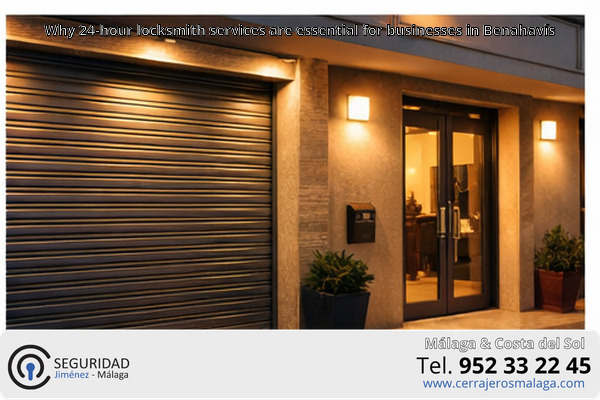
  • Why 24-hour locksmith services are essential for businesses in Benahavís

    Why 24-hour locksmith services are essential for businesses in Benahavís

    Have you ever found yourself locked out of your office in the middle of the night, wondering who to call for help? In Málaga, businesses face unique challenges when it comes to security and access. 24-hour locksmith services provide essential support to ensure your operations run smoothly, no matter the hour.

    What 24-hour locksmith services are and what business need they solve

    24-hour locksmith services provide professional assistance with urgent access, lock and security problems at any time of day or night. For businesses in Benahavís, this type of service can help restore access, protect premises and reduce disruption when a door, lock or key system fails outside normal working hours.

    Commercial premises depend on reliable access to offices, shops, storage areas, reception spaces, equipment rooms and other restricted zones. A lost key, damaged lock, blocked entrance or failed cylinder can affect employees, customers, suppliers and business assets. Waiting until the following day may not be practical when the incident prevents opening, closing or securing the property.

    Urgent locksmith assistance is not limited to opening doors. Depending on the situation, it may include the replacement of a cylinder, repair of a faulty lock, securing an access point after damage or the assessment of a wider access-control problem. The appropriate intervention depends on the type of door, the existing hardware, the cause of the failure and the security requirements of the business.

    When may a business need a 24-hour locksmith?

    Emergency assistance can be appropriate when an access problem affects the operation or security of commercial premises. Common circumstances include:

    • Lost, stolen or unaccounted-for keys that may allow access to the premises.
    • A key that is broken, difficult to turn or no longer operates the lock correctly.
    • A jammed entrance that prevents employees or authorised personnel from entering.
    • A door that cannot be locked securely after closing time.
    • Damage to a lock or door following an attempted break-in or accidental impact.
    • A failed lock on a storage room, office, cash-handling area or restricted zone.
    • A need to change a cylinder after staff changes or the loss of control over issued keys.
    • An urgent need to review access arrangements before the premises are left unattended.

    A locksmith intervention may not be necessary in every case. For example, a problem caused only by a misplaced key may be resolved through an authorised spare key if no security concern exists. However, when the key is lost outside the premises, the ownership of the key is uncertain or the lock shows signs of mechanical failure, a technical assessment is advisable.

    Before any work begins, the professional should verify the nature of the incident, the identity or authorisation of the person requesting assistance and the characteristics of the access point. This helps avoid replacing components unnecessarily or applying a solution that is incompatible with the existing installation.

    Why rapid assistance matters for commercial premises

    A delayed response to a lock problem can create several practical and security-related consequences. The main value of a 24-hour service is the possibility of assessing and addressing the incident when it occurs, rather than leaving the business exposed or unable to operate.

    • Operational interruption: employees may be unable to access the workplace, stockroom or equipment areas.
    • Unsecured premises: a door that cannot close or lock correctly may leave the business vulnerable after working hours.
    • Loss of access control: unreturned or missing keys can make it difficult to know who may still enter.
    • Additional damage: repeated attempts to operate a faulty lock may worsen the failure or damage the door hardware.
    • Restricted access to essential areas: a failed lock can affect documentation, stock, tools or other business resources.
    • Compliance and insurance concerns: the condition of doors and locks may be relevant to internal security procedures or insurance requirements, depending on the policy and circumstances.

    Professional intervention also helps distinguish between an isolated component failure and a broader problem involving alignment, door movement, cylinder wear or the condition of the locking mechanism.

    Options available for businesses

    Solution When it is used Advantages Limitations
    Emergency door opening When authorised personnel cannot access the premises because of a lost key, blocked lock or mechanical failure. Can restore access without replacing the complete door system when the hardware allows it. Does not necessarily resolve the underlying fault or address a lost-key security risk.
    Cylinder replacement When keys are lost, access control must be changed or the existing cylinder is worn or damaged. Can restore control over physical keys while retaining compatible door hardware. Compatibility, dimensions and security features must be checked before installation.
    Lock repair or replacement When the locking mechanism is damaged, worn or no longer operates consistently. Addresses a mechanical fault that may affect daily use and closing security. The solution depends on the door, lock type, condition and availability of compatible components.
    Commercial access assessment When the incident reveals wider problems with keys, restricted areas or access management. Helps identify weaknesses and organise a more suitable access arrangement. May require additional decisions about users, permissions and future maintenance.

    Criteria for choosing the right solution

    The most suitable response should be based on the actual needs of the business rather than on the urgency of the incident alone. Several factors influence the technical decision:

    • Number of users: a premises used by a small team may require a different key-management approach from a business with frequent staff changes.
    • Number of access points: entrances, internal offices, storage rooms and service areas may require separate permissions.
    • Working hours: businesses with extended or irregular schedules may need access arrangements that remain reliable outside standard office hours.
    • Frequency of use: high-use doors can experience more wear and may need closer attention to alignment and mechanical condition.
    • Need for access records: a conventional key system does not normally provide the same information as an electronic access-control system.
    • Compatibility: a replacement component must match the door, lock case, cylinder dimensions and any existing security hardware.
    • Maintenance: emergency repair should not replace periodic checks when a door is showing repeated signs of wear.
    • Scalability: the selected arrangement should be practical if the business later adds users, areas or access restrictions.
    • Available budget: the decision should consider both the immediate repair and the future cost of maintenance or replacement.

    No single system is suitable for every business. A technical assessment is especially important when several doors, different permission levels or existing electronic components are involved.

    Practical comparison between commercial access alternatives

    Traditional keys can be appropriate for straightforward access arrangements, but they require careful control when several employees share the premises. A cylinder change may be enough after a lost key or staff departure, while a broader access review may be advisable when the business has multiple restricted areas.

    Electronic access systems can offer features such as user management or event records, but their suitability depends on the existing installation, power supply, software and maintenance requirements. They should not be installed as an emergency replacement without checking compatibility and operational needs.

    Mechanical systems generally have a simpler operating principle, whereas electronic solutions may require additional components and technical support. The decision should therefore consider reliability, user management, the importance of audit information and the consequences of a possible system failure.

    Typical situations in businesses and commercial premises

    Lost keys outside working hours

    Need: An employee or manager cannot account for a key that may provide access to the business.

    Risk: Continuing to use the same cylinder may leave uncertainty about who could enter the premises.

    Technical criterion: The professional should determine whether the key identifies the premises, whether other keys remain in circulation and whether the cylinder shows signs of wear.

    Usual solution: Depending on the assessment, the cylinder may be replaced and new authorised keys issued.

    Expected result: The business regains control over physical access, subject to correct management of the new keys.

    Commercial entrance that will not lock at closing time

    Need: The business can close the door but cannot confirm that the locking mechanism is working correctly.

    Risk: The premises may remain insufficiently secured after employees leave.

    Technical criterion: The assessment should consider the lock, cylinder, door alignment, hinges, frame and the way the door is operated.

    Usual solution: The faulty component may be adjusted, repaired or replaced if it is no longer reliable.

    Expected result: The entrance should operate consistently, provided that the rest of the door assembly is in suitable condition.

    Blocked access to a restricted business area

    Need: Staff cannot enter an office, storage room or equipment area because the key does not operate the lock.

    Risk: Daily operations may be interrupted, and repeated force may damage the lock or door.

    Technical criterion: The professional should identify whether the cause is a damaged key, internal wear, misalignment or a problem with the locking mechanism.

    Usual solution: The access may be opened through an authorised locksmith intervention, followed by repair or component replacement when required.

    Expected result: Access is restored and the cause of the blockage is addressed rather than simply bypassed.

    Frequent mistakes when managing commercial locks

    Error Consequence Preventive criterion
    Waiting until a worn key stops working completely The failure may occur when the premises must be opened or secured urgently. Replace or assess keys and cylinders when turning becomes difficult or irregular.
    Replacing a cylinder without checking dimensions and compatibility The new component may not fit correctly or may not work with the existing lock and security hardware. Verify the door, cylinder, lock case and any protective elements before selecting a replacement.
    Allowing keys to circulate without responsibility The business may lose control over who has access to the premises or restricted areas. Keep an updated record of issued keys and recover them when access permissions change.
    Forcing a door or key when the mechanism is blocked The lock, cylinder, door or frame may suffer additional damage. Stop using the access point and request a technical assessment when normal operation fails.
    Assuming every access problem requires a complete replacement Unnecessary work and compatibility problems may arise. Identify the failed component before deciding between adjustment, repair or replacement.

    Aspects of the service in Málaga and Benahavís

    Benahavís is located in Málaga and forms part of the wider Costa del Sol business environment. For a commercial emergency, the relevant issue is not only the distance to the premises but also the type of access, the availability of compatible components and the information that can be provided before the visit.

    A service provider operating in Málaga and the Costa del Sol should evaluate the location, access conditions and urgency of the incident when coordinating assistance. Details such as whether the door is an entrance, internal office, storage area or restricted zone can help define the likely technical requirements, although the final decision normally requires an on-site assessment.

    Cerrajerosmalaga offers locksmith assistance for businesses and other premises, including door opening, cylinder replacement and 24-hour locksmith support. Its service coordination is associated with Málaga and the Costa del Sol. The applicable intervention depends on the existing installation and the specific circumstances of the business in Benahavís.

    Frequently asked questions about 24-hour locksmith services for businesses in Benahavís

    Why are 24-hour locksmith services important for businesses?

    They provide a way to address urgent access or security problems outside standard working hours. This can help reduce operational disruption and avoid leaving a commercial property unsecured while waiting for assistance.

    Does a 24-hour service only open locked doors?

    No. Depending on the situation, it may involve opening an authorised access point, replacing a cylinder, repairing a lock or assessing why a door cannot be secured correctly.

    When should a business change its cylinder after losing a key?

    The decision depends on whether the key could be linked to the premises, whether its location is known and how important the affected access is. If control over the key cannot be confirmed, cylinder replacement may be considered after a technical assessment.

    Can an emergency intervention be carried out without replacing the entire lock?

    In some cases, yes. The appropriate solution depends on which component has failed and whether the existing lock, cylinder and door hardware remain compatible and serviceable.

    How long does a commercial locksmith intervention take?

    There is no universal time because the duration varies according to the type of door, the cause of the problem, the condition of the hardware and the work required. A more accurate assessment is possible once the access point has been inspected.

    Can a locksmith determine whether a problem is caused by the door or the lock?

    A technical inspection can distinguish between issues involving the cylinder, lock mechanism, door alignment, frame, hinges or the key itself. This distinction is important because replacing only one component may not resolve an alignment or structural problem.

    Is it advisable to install an electronic access system during an emergency?

    Not automatically. Electronic systems may be useful for some businesses, but their compatibility, power supply, user management and maintenance requirements should be evaluated before installation.

    What information should a business provide when requesting assistance?

    It is useful to explain the location, the type of premises, the affected access point, the symptoms observed and whether the door is currently open, closed or damaged. The provider may also need to verify that the person requesting the service is authorised to act for the business.

    Technical summary for making a decision

    For businesses in Benahavís, 24-hour locksmith services can be important when a lost key, failed lock, blocked entrance or damaged access point affects operations or premises security. The correct response may involve emergency opening, cylinder replacement, lock repair or a broader review of commercial access management.

    The choice depends on the number of users, access points, working patterns, security requirements, existing hardware, maintenance needs and available budget. A rapid response does not replace technical diagnosis: the door, lock, cylinder and surrounding installation should be checked before selecting a solution.

    Assistance coordinated through Málaga and the Costa del Sol can be relevant for businesses in Benahavís, but the scope and duration of each intervention depend on the specific property and fault. For information about locksmith support for commercial premises, Cerrajerosmalaga is available through its online service information at blog.cerrajerosmalaga.com.
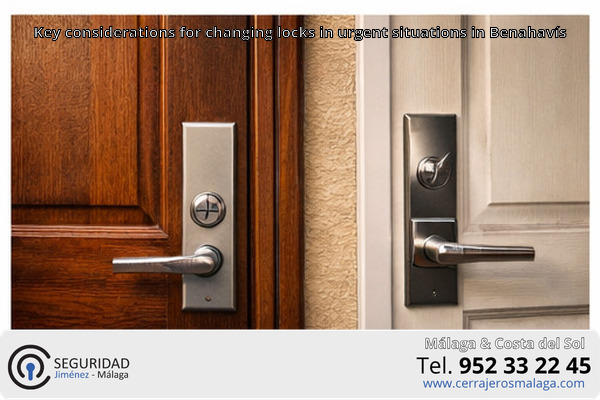
  • Key considerations for changing locks in urgent situations in Benahavís

    Key considerations for changing locks in urgent situations in Benahavís

    Have you ever found yourself locked out of your home in Benahavís, feeling a rush of panic over lost keys? In homes across Málaga, knowing when and how to change locks urgently is crucial for your security. Discover the key considerations that will help you navigate these stressful situations with ease.

    What urgent lock changing in Benahavís involves and what it is for

    Urgent lock changing is the technical replacement of a lock, cylinder or related door component when the existing access system can no longer provide reliable or controlled entry. In Benahavís, Málaga, this intervention may be necessary after lost keys, a suspected unauthorised copy, a break-in attempt, a damaged lock or an unexpected failure that prevents normal use of the door.

    The objective is not simply to fit a new component. A proper intervention assesses the door, the existing locking mechanism, the condition of the frame and the level of access control required. Depending on the installation, the appropriate solution may involve changing the cylinder, replacing the complete lock, repairing a damaged mechanism or adapting the door to a compatible security component.

    In urgent situations, the work must balance speed with a correct diagnosis. Replacing a component without checking its compatibility can leave the door difficult to operate, reduce security or create new faults.

    When changing a lock may be necessary

    An urgent lock change is generally considered when the key or locking system creates an immediate access or security concern. The most common situations include:

    • Lost or stolen keys: changing the cylinder can prevent the missing key from continuing to operate the door.
    • Uncertainty about who has a copy: this may occur after a tenancy change, a staff change or the handover of keys to third parties.
    • Signs of attempted manipulation: visible damage, unusual marks or a lock that no longer operates normally require technical assessment.
    • Repeated jamming: resistance when inserting or turning the key may indicate wear, misalignment or an internal fault.
    • Broken or severely worn components: a damaged cylinder or lock may prevent the door from closing or being secured correctly.
    • Change of access permissions: replacing the locking component can be appropriate when former users should no longer have access.

    A lock change may not be necessary in every incident. If the problem is caused only by door misalignment, a loose fitting or a defective key, adjustment or repair may be sufficient. The decision should therefore be based on an inspection rather than on the symptom alone.

    What risks or problems it helps to prevent

    Changing a lock in an urgent situation can reduce several practical and security-related risks, although the level of protection depends on the complete door assembly and the component selected.

    • Unauthorised access: a new cylinder can invalidate keys that are missing or no longer trusted.
    • Unexpected lockouts: replacing a worn mechanism may prevent a failure that leaves occupants outside or unable to secure the property.
    • Progressive wear: early intervention can avoid further deterioration of the key, cylinder or internal lock components.
    • Loss of door functionality: an incorrectly operating lock can affect closing, opening and secure latching.
    • Weaknesses in older installations: a technical assessment may identify an outdated or poorly protected component.
    • Uncontrolled copies: changing the locking element provides an opportunity to reorganise who should hold valid keys.

    Replacing only the visible part of a door does not automatically resolve every security weakness. The condition of the frame, hinges, strike plate and door structure must also be considered.

    How an urgent lock-changing intervention is carried out

    A professional intervention should follow a structured process, even when the request is time-sensitive.

    1. Initial assessment: the technician identifies the type of door, the immediate problem and whether the property can currently be secured.
    2. Diagnosis of the existing system: the cylinder, lock body, fittings, door alignment and frame are checked to determine whether the fault is local or affects the complete assembly.
    3. Selection of the appropriate solution: the decision may be to change the cylinder, replace the lock, repair the mechanism or use a compatible security component. The required key configuration and door use are also considered.
    4. Intervention: the defective or compromised component is replaced or repaired while preserving the correct operation of the door and avoiding unnecessary damage.
    5. Final checks: the door is tested from the relevant sides, with the door open and closed, to verify locking, unlocking, alignment and smooth operation.

    In urgent work, it is also important to verify that the person requesting the intervention is authorised to access or manage the property. The precise checks depend on the circumstances and the type of property.

    Alternatives and related systems

    Solution When it is used Advantages Limitations
    Cylinder replacement When the lock body is serviceable but existing keys must be invalidated or the cylinder is worn. Usually focuses the intervention on the access-control component and can preserve the existing lock body. It may not resolve faults in the internal mechanism, door alignment or frame.
    Complete lock replacement When the internal lock is damaged, unreliable or incompatible with the required use. Addresses the main locking mechanism as a complete unit. Compatibility, measurements and door preparation must be checked before installation.
    Lock repair or adjustment When the fault is caused by misalignment, loose fittings or a repairable mechanical issue. May avoid replacing components that remain in usable condition. It is not suitable when keys are compromised or the mechanism is extensively worn.
    Electronic or smart locking system When the property requires an alternative method of access management. May provide different permission-management options depending on the system. Requires compatibility, power management, configuration and appropriate maintenance.

    Common situations in residential interventions

    Lost keys after leaving the property

    Situation: the occupant has lost a key and cannot establish whether it can be linked to the address.

    Problem detected: the existing cylinder remains operational, but the validity of the missing key is uncertain.

    Technical assessment: the technician checks the cylinder type, the lock measurements and the condition of the door before deciding whether a cylinder change is sufficient.

    Usual solution: replacement of the cylinder with a compatible component, followed by testing with the new keys.

    Expected result: the lost key should no longer operate the replaced cylinder, subject to the correct installation and the absence of other access points using the same key.

    Key turns with resistance and the door intermittently jams

    Situation: the door can sometimes be opened but the key requires increasing force.

    Problem detected: the cause may be a worn cylinder, a damaged lock body or pressure caused by door and frame misalignment.

    Technical assessment: the lock is tested separately from the door position to distinguish a component fault from an alignment problem.

    Usual solution: adjustment or repair where appropriate, or replacement of the affected component if wear makes continued use unreliable.

    Expected result: smoother operation and a more reliable closing system, provided that the door structure and fittings are also in suitable condition.

    Damage following a suspected attempt to force the door

    Situation: the lock or surrounding fittings show visible damage and the occupant needs to secure the property.

    Problem detected: the cylinder, lock, escutcheon, door edge or frame may have suffered different levels of damage.

    Technical assessment: the whole access assembly is reviewed rather than replacing only the most visible part.

    Usual solution: replacement of damaged components and, where necessary, reinforcement or adjustment of compatible fittings.

    Expected result: restoration of normal locking and identification of any remaining weakness that requires a separate security improvement.

    Frequent mistakes and how to avoid them

    Mistake Possible consequence Technical recommendation
    Choosing a replacement only by appearance The component may not fit the door or may not provide the required operation. Verify dimensions, fixing points, door type and compatibility before purchase or installation.
    Replacing the cylinder without checking the lock and frame The original problem may continue if it is caused by misalignment or a damaged internal mechanism. Assess the complete locking assembly.
    Forcing a key that is already damaged The key may break inside the cylinder or increase the damage. Stop using the key when resistance or deformation is detected and request a technical evaluation.
    Delaying action after losing keys An unknown person may retain a valid means of access. Consider changing the relevant locking component promptly after assessing the risk.
    Ignoring final testing A door may appear closed while the latch or deadbolt is not operating correctly. Test the system repeatedly from the appropriate sides and with the door in its normal closed position.

    Aspects to consider in Málaga and Benahavís

    The technical solution in Benahavís depends on the property, the type of door, the existing lock and the circumstances of the incident. Homes, villas, apartments, holiday properties and buildings with shared access may require different assessments.

    For urgent requests in Benahavís, it is useful to provide clear information about whether the door is open or closed, whether the key is available, whether there is visible damage and whether the property is a private residence or part of a shared building. Photographs may help with an initial assessment, although the final choice of component normally requires an on-site inspection.

    Cerrajerosmalaga coordinates locksmith services from Málaga and provides urgent assistance for homes, businesses and communities in the province and Costa del Sol area, subject to the circumstances of the request and technician availability. The intervention should take account of travel requirements, access to the property and the need to verify the installation before selecting a replacement.

    Frequently asked questions about changing locks urgently in Benahavís

    Should the lock always be changed after losing a key?

    Not automatically, but the risk should be assessed. If the key can be associated with the property, was stolen or may be accessible to an unknown person, changing the cylinder is often considered. A professional can determine whether a cylinder replacement or another measure is appropriate.

    Is it necessary to replace the complete lock?

    No. If the lock body and door mechanism are in good condition, replacing the cylinder may be sufficient. A complete lock replacement is considered when the internal mechanism is damaged, worn or incompatible with the required solution.

    Can a lock be changed if the door is locked?

    The procedure depends on the condition of the lock, the type of door and whether the mechanism is operating. The technician must first assess the situation and use an appropriate professional procedure that avoids unnecessary damage. No intervention should be carried out without confirming authorisation.

    How long does an urgent lock change take?

    The time varies according to the door, access conditions, diagnosis and availability of a compatible component. A straightforward cylinder replacement may differ substantially from work involving a damaged lock, a misaligned door or additional security fittings.

    What information should be provided when requesting assistance?

    Useful information includes the location in Benahavís, the type of property, whether the door is open or closed, the symptoms observed, whether keys have been lost and whether there is visible damage. This helps determine the likely scope of the assessment.

    Is a smart lock suitable for an urgent replacement?

    It depends on the door, the existing lock, the power supply, the required access method and the user’s ability to manage the system. An electronic solution should not be selected solely because it is available; compatibility and future maintenance must be evaluated.

    Does changing the front-door cylinder secure every access point?

    No. Other doors, windows, garages, communal entrances or secondary access points may use different systems. A complete security review should identify which access points are affected by the lost key or suspected compromise.

    Technical summary

    Urgent lock changing in Benahavís is intended to restore controlled access when keys are lost, security is uncertain, a mechanism is damaged or normal operation has become unreliable. The correct solution may be a cylinder replacement, a complete lock change, a repair or an alternative access system.

    The essential criteria are diagnosis, compatibility, the condition of the door and frame, the number of affected access points and the level of control required. A rapid intervention should still include final checks to confirm correct locking and unlocking. Because the appropriate solution depends on the existing installation, an on-site technical assessment remains necessary in situations involving damage, repeated jamming or changes in access permissions.

  • Emergency locksmith services for residential properties in Benahavís

    Emergency locksmith services for residential properties in Benahavís

    Have you ever found yourself locked out of your home in a moment of panic? In the beautiful region of Málaga, it’s common to face unexpected lock issues that leave you feeling vulnerable. Emergency locksmith services for residential properties in Benahavís are here to provide you with the immediate assistance you need to regain access and ensure your home’s security. Read on to discover how these services can help you in times of need.

    What emergency locksmith services for residential properties in Benahavís are and what they are for

    Emergency locksmith services for residential properties in Benahavís provide technical assistance when a home cannot be accessed, secured or used normally because of a lock, door or key-related problem. These services may include non-destructive door opening where technically possible, lock or cylinder replacement, lock repairs and urgent assistance after lost keys, a damaged lock or a blocked entrance.

    The appropriate intervention depends on the type of door, the condition of the locking mechanism, the cause of the incident and the level of security required after access has been restored. A professional assessment should distinguish between a temporary access problem and a failure that could leave the property vulnerable.

    In the Málaga and Costa del Sol area, emergency locksmith assistance may be required in detached houses, apartments, holiday properties, rental homes and residential developments. Availability in Benahavís depends on the requested service, the location of the property and the conditions of the intervention.

    When emergency residential locksmith assistance may be necessary

    An emergency locksmith visit is normally considered when a resident cannot enter or secure the property safely. Common situations include lost keys, keys left inside the home, a key that has broken in the lock, a cylinder that no longer turns or a door that remains blocked despite using the correct key.

    • Lost or stolen keys: access may be restored, followed by an assessment of whether the cylinder should be replaced to reduce the risk of unauthorised entry.
    • Damaged or broken locks: wear, forced movement, incorrect alignment or internal failure can prevent normal locking and unlocking.
    • Blocked doors: a door may remain closed because of a malfunctioning cylinder, multipoint mechanism, latch or alignment problem.
    • Keys left inside the property: the intervention should focus on restoring access while avoiding unnecessary damage to the door and frame.
    • Urgent security changes: a lock or cylinder replacement may be appropriate after a key has been lost, a tenant has left or there is uncertainty about who holds copies.
    • Failure of an electronic residential lock: the cause may involve the power supply, control unit, credential or mechanical override, so the system must be identified before any component is changed.

    An emergency call is not always the same as an immediate replacement. If the lock works correctly and the concern is preventive, a scheduled security assessment may be more appropriate. Before intervention, it is useful to establish whether the door is closed or open, whether the key turns partially, whether the lock has visible damage and whether other entrances are affected.

    What risks or problems the service helps to prevent

    Prompt technical attention can help prevent a temporary access problem from becoming a wider security or maintenance issue. A defective lock may progressively deteriorate, cause repeated blockages or leave the door unable to close properly.

    • Unauthorised access: replacing a compromised cylinder can be considered when keys are missing or their control is uncertain.
    • Repeated lockouts: repairing the underlying fault is preferable to relying on repeated emergency openings.
    • Additional damage: forcing a key, pushing a misaligned door or repeatedly operating a failing mechanism can damage internal components.
    • Loss of locking functionality: a door that appears closed may not be properly secured if the latch or locking points do not engage correctly.
    • Accelerated wear: stiffness, scraping or abnormal resistance can indicate an alignment or mechanism problem that requires assessment.
    • Weaknesses after a security incident: an inspection can determine whether the cylinder, escutcheon, frame or complete locking system needs attention.

    Emergency assistance does not automatically eliminate every security risk. The protection of a home depends on the complete door assembly, including the frame, hinges, lock, cylinder, escutcheon, installation quality and the way the door is used.

    How an emergency residential locksmith intervention is carried out

    A professional intervention should follow a controlled sequence. The precise procedure varies according to the door and lock, but the main technical decisions usually follow these stages:

    1. Initial assessment: the technician confirms the property, the nature of the incident and whether the person requesting assistance is authorised to access it.
    2. Diagnosis of the existing system: the door type, lock configuration, cylinder, multipoint mechanism, electronic components and visible signs of damage are identified.
    3. Selection of the solution: the technician determines whether the appropriate response is an opening, adjustment, repair, cylinder change, lock replacement or another compatible measure.
    4. Intervention: the selected work is carried out with attention to the door, frame and locking components. The method depends on the condition and design of the installation.
    5. Final checks: the door is tested from the inside and outside where appropriate, the key operation is checked and the locking points are verified for correct engagement.

    The distinction between a cylinder fault and a wider multipoint lock fault is especially important. Replacing only the visible component may not resolve the problem if the mechanism, door alignment or frame is also affected.

    Alternatives and related residential locking systems

    Solution When it is used Advantages Limitations
    Emergency door opening When authorised residents cannot access a closed property Focuses on restoring access without automatically replacing the complete lock It does not correct a defective or compromised mechanism by itself
    Cylinder replacement After lost keys, uncertain key control, wear or cylinder failure Can restore key control while retaining compatible parts of the door Compatibility, dimensions and security features must be checked
    Lock repair or adjustment When the mechanism is serviceable but affected by wear or alignment Addresses the identified fault without necessarily replacing all components Not suitable when internal parts are damaged or obsolete
    Complete lock replacement When the lock body or multipoint mechanism has failed or is unsuitable Provides a new compatible locking assembly May require more extensive work and accurate measurement
    Electronic or smart residential lock assessment When access depends on a keypad, credential, motor or control system Allows mechanical and electronic causes to be separated Compatibility, power supply and manufacturer-specific components may limit the options

    Common situations in residential emergency interventions

    Lost keys at a property entrance

    Situation: A resident has lost the keys to a house or apartment and cannot enter.

    Problem detected: There is both an access problem and uncertainty about whether another person could use the missing keys.

    Technical assessment: The technician identifies the door and cylinder, checks for damage and determines whether access can be restored without replacing the complete lock.

    Usual solution: Access is restored first when possible, followed by cylinder replacement if the loss represents a relevant security concern.

    Expected result: The resident can access the property and, where a new cylinder is installed, the missing key should no longer operate the new locking component.

    A key turns with difficulty or does not complete the locking movement

    Situation: The key enters the cylinder but becomes stiff, rotates only partially or fails to operate the door consistently.

    Problem detected: The cause may be cylinder wear, door misalignment, pressure on the locking points or a failure inside the multipoint mechanism.

    Technical assessment: The complete interaction between the door, frame and lock is checked rather than assuming that the cylinder alone is defective.

    Usual solution: Depending on the diagnosis, the response may involve adjustment, repair, cylinder replacement or replacement of the lock mechanism.

    Expected result: The key should operate smoothly and the locking points should engage correctly, provided that the rest of the installation is in suitable condition.

    A residential door remains blocked after a lock failure

    Situation: The door cannot be opened or secured after an internal failure or a sudden obstruction.

    Problem detected: Continued force may damage the key, cylinder, door or frame.

    Technical assessment: The type of lock, door construction and symptoms are assessed before selecting an intervention method.

    Usual solution: An authorised emergency opening is carried out, followed by an inspection of the failed components and a recommendation for repair or replacement.

    Expected result: Access or security is restored, subject to the condition of the door and the extent of the mechanical failure.

    Frequent mistakes and how to avoid them

    Mistake Consequence Technical recommendation
    Forcing a key that is already bent or damaged The key may break inside the cylinder and complicate the intervention Stop using the key when resistance is abnormal and request an assessment
    Replacing a cylinder without checking the lock dimensions The new component may be incompatible or incorrectly positioned Verify measurements, cam position, door configuration and the complete locking system
    Assuming that every blocked door requires a complete replacement Unnecessary work may be carried out while the actual issue is alignment or adjustment Diagnose the door, frame and mechanism before selecting components
    Using generic components without checking compatibility The lock may work inconsistently or fail to provide the intended functionality Match the replacement to the existing installation and the required level of use
    Ignoring stiffness after the door has been opened The original fault may return or become more serious Test the operation and arrange repair or maintenance when abnormal resistance remains
    Leaving copies of keys uncontrolled after a security concern Unauthorised persons may retain access Review who holds keys and consider a cylinder change where appropriate

    Factors to consider in Málaga and Benahavís

    Residential locksmith assistance in Benahavís forms part of a wider service area covering Málaga and the Costa del Sol. The practical conditions of each call may vary according to the exact location, the type of property, access to the building or urbanisation and the work required.

    Detached houses, apartments and holiday properties can have different door constructions and locking systems. A property that is unoccupied for periods of time may also require particular attention to key control and the condition of the lock after prolonged inactivity. These factors should be assessed individually rather than assumed from the location alone.

    When requesting assistance through Cerrajerosmalaga, it is useful to provide the property location, explain whether the door is open or closed and describe any symptoms such as a broken key, stiffness or a lock that does not turn. This information helps determine the type of technician and equipment required, although an on-site assessment may still be necessary.

    The service is provided by a business focused on opening doors, changing cylinders and urgent 24-hour locksmith assistance for homes, businesses and communities. The final intervention depends on the existing installation, the cause of the fault and the solution authorised by the property owner or resident.

    Frequently asked questions about emergency locksmith services for residential properties in Benahavís

    What does an emergency residential locksmith service include?

    It may include urgent assistance for blocked doors, lost keys, damaged locks, cylinder faults and other access or security incidents. The exact work depends on the diagnosis and may involve opening, adjustment, repair or replacement.

    Is it always necessary to replace the lock after losing a key?

    Not always. The decision depends on whether the missing key could be associated with the property, who may have access to it and the condition of the existing cylinder. A cylinder change may be advisable when key control cannot be confirmed.

    Can a lock be repaired instead of replaced?

    In some cases, yes. Repair or adjustment may be suitable when the mechanism is compatible and the fault is limited to alignment, wear or a replaceable component. Replacement may be necessary when internal parts are damaged or the system is no longer appropriate.

    How long does an emergency locksmith intervention take?

    There is no single time applicable to every call. The duration depends on the distance, access conditions, door construction, lock type, damage and whether replacement parts are required. An accurate assessment is possible only after the situation is understood.

    What information should be provided when requesting assistance in Benahavís?

    The caller should provide the location, type of property, current position of the door, nature of the fault and whether there are signs of damage. It is also useful to explain whether the problem concerns a traditional cylinder, a multipoint lock or an electronic access system.

    Can emergency assistance be requested for a smart or electronic residential lock?

    It can be assessed, but the response depends on the system installed. The fault may involve batteries, credentials, electronic control or the mechanical override. Compatibility and the availability of suitable components must be verified before replacement.

    What should be done if the door closes but does not lock correctly?

    The door should not be considered secure until the latch and locking points have been checked. Avoid forcing the key or repeatedly operating the mechanism, and request a technical inspection of the alignment, lock and frame.

    Does opening the door resolve the underlying problem?

    Not necessarily. Opening restores access, but a defective cylinder, damaged mechanism or security concern may remain. The system should be tested afterwards to determine whether repair, adjustment or replacement is required.

    Technical summary

    Emergency locksmith services for residential properties in Benahavís are intended to restore access or security when a home is affected by lost keys, blocked doors, damaged cylinders, lock failures or other urgent incidents.

    • The first step is to identify the symptoms and assess the complete door and locking system.
    • An opening, adjustment, repair, cylinder change or complete lock replacement may be appropriate depending on the diagnosis.
    • Lost keys can create a security concern even when the lock itself is working correctly.
    • Forcing keys or replacing components without checking compatibility can worsen the fault.
    • Electronic and mechanical systems require different diagnostic criteria.
    • Availability and intervention conditions in Benahavís depend on the exact property, access requirements and service requested.
    • A final operational check is necessary after any emergency intervention.

    Professional assessment remains essential because the correct solution depends on the existing installation, the cause of the problem and the security needs of the property. Cerrajerosmalaga provides information and assistance for residential locksmith requirements in Málaga and the Costa del Sol through its service channels.