
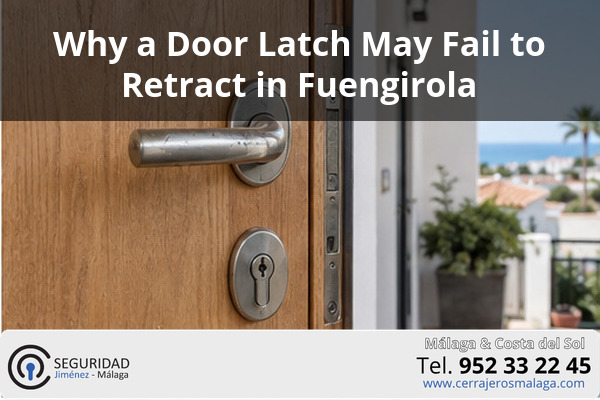
A door latch in Fuengirola may fail to retract because the door is misaligned, components are worn, or the handle or lock mechanism is faulty. Check whether it moves with the door open before assuming the whole lock needs replacing. Learn how to make this check safely, recognise signs of alignment or mechanism problems, and decide when to contact a locksmith without forcing the door.
A door latch is the spring-loaded part that moves into the strike plate when a door closes and retracts when the handle is turned. In Fuengirola, it may fail to retract because of door misalignment, a worn latch or handle mechanism, or a problem inside the lock. Forcing the handle can worsen the fault or leave the door stuck.
Misalignment and worn components are common causes
If the latch retracts with the door open but catches when the door is closed, the latch and strike plate may no longer line up. A door can shift slightly over time, or hinges and fixings can loosen. The latch may then rub against the edge of the strike plate instead of moving freely into it.
If the latch does not retract even with the door open, the problem is more likely in the handle, spindle, latch spring or lock mechanism. Dirt or a lack of suitable maintenance may also affect movement. A key-operated deadbolt is a separate part: a fault with the latch does not automatically mean the cylinder needs replacing.
Imagine a shop owner in Fuengirola finds that the door handle works normally in the morning but the latch catches against the frame when closing time comes. Rather than pushing harder, the owner keeps the door from being slammed and notes whether the handle moves freely while the door is open. A locksmith inspects the handle, latch and alignment, then explains which part needs attention. The useful lesson is to identify where movement stops before deciding that the whole lock must be replaced.
Simple checks can help identify where movement stops
When it is safe to do so, open the door and turn the handle gently. Watch whether the latch retracts fully and returns when the handle is released. If it moves smoothly while open but catches against the frame when closed, alignment is a likely factor. If it remains stuck in either position, the handle or internal mechanism may need professional inspection.
- Latch retracts with door open
- Check for contact with the strike plate when closed.
- Latch stays extended
- The handle or latch mechanism may be worn or jammed.
- Handle feels loose
- Its connection to the latch may need inspection.
- Door must be pushed hard
- Stop forcing it; pressure can aggravate the fault.
Do not use excessive force, hit the door, or keep turning a handle that feels stuck. Avoid removing lock parts unless you are qualified to do so; dismantling can complicate the diagnosis and may affect the door’s security. If the door is your responsibility, arrange access for a locksmith and explain what happens with the door open and closed.
Choose the next step based on the door’s symptoms
For a door that still opens and closes, limit use if the latch catches and arrange an inspection before the fault leaves the door difficult to secure. For a door that will not open or close safely, contact a locksmith rather than trying to force the latch. A technician can assess whether the cause is alignment, the handle, the latch or another part of the lock, and explain the appropriate work before proceeding.
Seguridad Jiménez provides 24-hour locksmith assistance in Fuengirola and other main Costa del Sol locations, including help with blocked access and lock problems. When contacting a locksmith, describe whether the latch moves with the door open, whether the handle feels loose, and whether the fault began suddenly. These details can help focus the assessment. Seguridad Jiménez can be contacted on 952 33 22 45.
The key is to identify whether the latch fails with the door open or only when it meets the frame, and avoid forcing it in either case.